
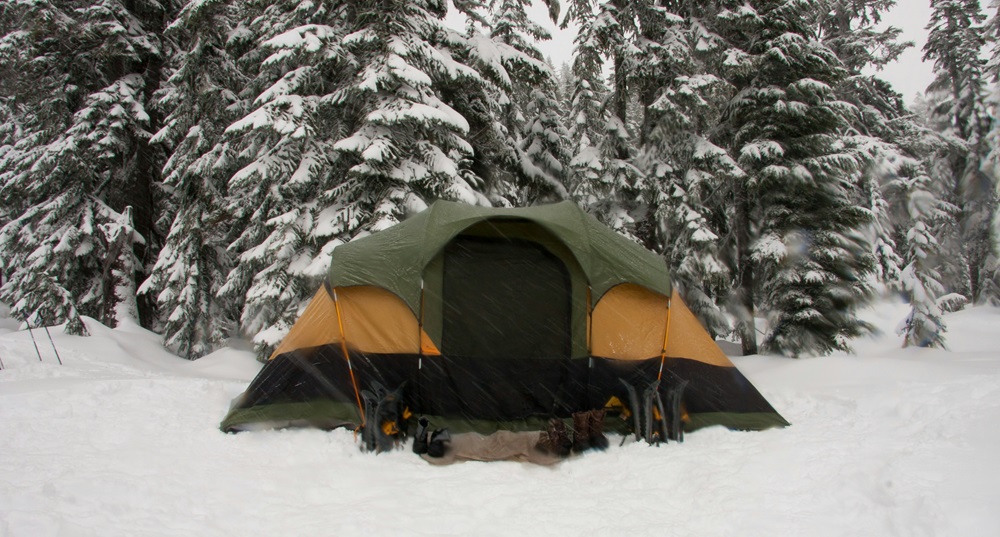
Planning a year-long trip across wildly different climates is one of the more complex gear puzzles out there. You need something that holds up in Balkan snowstorms, mountain winds in Pakistan, and the muggy, bug-heavy nights of Southeast Asia.
If you’ve been searching for 4-season tents for sale that can do all of that, this guide will help you figure out what’s actually realistic and which options come closest.
The honest truth about “4-season” tents
There’s no such thing as a tent that’s equally good in deep winter snow and 35°C tropical humidity. A tent built to keep cold air out and shed heavy snow loads will trap heat in summer. One with a full mesh inner breathes beautifully in Laos but offers little protection against spindrift in a mountain storm.
That gap is real, and it’s worth accepting before you spend $700 or more on a single shelter.
What you’re actually looking for is a tent with enough flexibility to handle both extremes reasonably well, or a modular system where you can swap components as the climate changes.
What your specific route demands
If you’re going from winter in the Balkans and Turkey through spring in Pakistan and China’s mountain ranges, then into the heat of Southeast Asia, you’re dealing with 3 distinct shelter needs:
- Winter/early spring: Snow load resistance, strong pole structure, wind stability, sealed floor
- Mountain spring: Rain protection, some wind handling, condensation management
- Tropical summer/autumn: Maximum airflow, full mesh inner, bug protection
A tent that scores 9/10 for winter will likely score 5/10 for tropical use. That’s the trade-off you’re managing.
The 3 tents people compare most for this kind of trip
SlingFin Portal 2
The SlingFin Portal 2 gets a lot of attention for its wind resistance. It’s freestanding, has an internal pole system that holds up well in storms, and the double-wall structure manages condensation better than many tents in its weight class.
The concern for year-long use is the full mesh inner. In a sandstorm or a prolonged cold snap with wind-driven snow, that mesh lets in more than you want. SlingFin built it that way intentionally for ventilation, and it works brilliantly in warm climates. But you’ll feel it in genuinely cold, blowing conditions.
At 190 cm, you’d likely be comfortable inside a 2-person configuration, though you’ll want to check the actual usable length, not just the stated floor length.
SlingFin Crossbow 2
The SlingFin Crossbow 2 Four-Season is the more winter-focused sibling. Its WebTruss system gives it real structural strength, and the ripstop inner handles spindrift and dust well, making it a good pick for desert camping too, not just snow.
The key thing to know: SlingFin sells a separate mesh body for the Crossbow. That means you can swap inners depending on conditions, which turns it into a much more versatile system than a fixed-inner tent. You’d carry two inner bodies and switch them out as your route changes. That adds weight and cost, but it’s the closest thing to a genuine quiver-killer in this lineup.
One person who’s used it in Colorado winter conditions described it as exactly what they wanted: strong enough for wind and snowfall, without being in the 8-pound category.
Terra Nova Voyager Lite
The Terra Nova Voyager Lite is a semi-geodesic 1-person tent that weighs around 1.49 kg. It’s been a favourite among UK trekkers for all-season use, and the 2025 version uses improved PFC-free fabrics.
The trade-off for a taller person is real. At 190 cm, the stated interior length will feel snug, especially once a sleeping bag and insulation are inside. The Voyager Lite is designed for the solo backpacker moving efficiently, not for comfortable long-term living.
If you value weight savings and weather resistance over interior space, it’s worth considering. If livability matters across weeks of use, you may find it cramped.
Other options worth knowing
Hilleberg Akto (with mesh inner)
The Hilleberg Akto is a 1-person tunnel tent built around Hilleberg’s Kerlon 1200 fabric. It’s legitimately four-season capable and has a mesh inner option for warmer conditions. For a solo traveller who prioritises weather reliability above everything else, Hilleberg is the benchmark.
The downside: it’s a solo tent, so you lose the extra space you might want for gear on a year-long trip. Hilleberg also makes the Enan, which is lighter.
Tarptent Double Rainbow DW
The Tarptent Double Rainbow is a popular choice for 2-person use on long-distance routes. It’s freestanding with trekking poles, has dual doors and vestibules, and handles rain and moderate wind well.
It’s primarily a 3-season tent, though. If you’re going through mountain terrain with serious snow and wind, it’s not where you want to be. For the warmer half of your trip, it’s excellent.
MLD Duomid (with mesh inner)
The Mountain Laurel Designs Duomid is a pyramid tarp requiring a single trekking pole. Weighs around 15 to 18 oz depending on fabric. You can add a mesh inner for bugs or a solid inner for cold.
The advantage is adaptability. You carry the shell and swap inners. The limitation in winter is staking: in loose or icy snow, getting reliable tension from stakes takes more effort than with a freestanding tent. In wet snow in the Sierra, staking is easy. In the powder snow of high-altitude Pakistan or Iran, it depends on what you’re dealing with.
Durston X-Mid Pro 2
The Durston X-Mid Pro 2 is an ultralight tarp-tent made from Dyneema Composite Fabric. You can pitch just the inner for bugs, just the outer for rain and wind, or both together. It’s versatile in the 3-season range, and the Dyneema fly handles rain well.
The limitation for true winter use is that staking is essential for the X-Mid system. On snow or rocky ground, setup gets harder. It’s not a go-to for Himalayan conditions, but it handles a wide range of milder conditions very well.
The two-tent option
Experienced long-distance campers raise this repeatedly: send one tent home and receive the other by post when your climate changes.
Start with a genuine 4-season tent (Crossbow, Akto) for winter. When you reach Thailand or Vietnam, have a friend post you a lighter 3-season tent and send the winter tent home. You travel with the right tool for each environment rather than one compromised tool for all of them.
It costs more upfront and requires logistics, but for a year-long trip, it’s worth thinking through.
What to prioritize if you stick with one tent
If you’re set on a single tent for the full route, here’s how to think about it:
- Get a tent with swappable inners (Crossbow 2 with mesh body purchase, or a mid system with inner options). This is the most practical compromise.
- Prioritize pole strength and floor integrity over weight. A floor failure or pole snap in a Pakistani mountain storm at altitude is a serious situation.
- For interior length, add 15 to 20 cm to your height and check the actual usable floor dimension, not the manufacturer’s peak length.
- Check lead times before buying. Some ultralight tents have 8 to 10 week waits from smaller manufacturers.
- Think about long-term floor durability for daily use over months. Heavy PU-coated floors delaminate. Silicone-coated and Dyneema floors hold up better.
FAQ
How do I keep warm in a 4-season tent without it getting unbearably hot in summer?
The tent itself doesn’t keep you warm. Your sleeping bag and clothing do. A 4-season tent adds minimal warmth on its own. What it does is block wind and reduce cold air infiltration. In summer, even a well-ventilated 4-season tent will feel stuffy. If you have a mesh inner option, use it with the fly pitched high and doors open.
Can I use a pyramid mid shelter like the MLD Duomid in genuine winter conditions?
Yes, with caveats. Pyramid shelters handle wind very well because they have no large vertical side panels to catch gusts. In snow, the main variable is ground conditions. In wet, packable snow, staking is easy, and the shelter performs well. In dry powder or rocky frozen ground, getting tension from stakes is harder. Most experienced winter users bring larger anchors or improvise with rocks and deadman stakes.
What’s the difference between a 3-season and a 4-season tent for the purposes of long trips?
The main differences are pole count and strength, inner tent material (mesh vs solid fabric), and floor construction. A 4-season tent has more poles (or a stronger pole geometry), a solid or mostly solid inner that blocks wind and spindrift, and a floor rated for harsher use. A 3-season tent has more mesh, fewer poles, and is built for rain and mild wind rather than sustained snowfall and high wind loads.
Do I need to re-seam-seal my tent before a year-long trip?
It depends on the tent’s age and prior use. Most factory seam sealing lasts 2 to 3 years with regular use. Before a long trip, check all the seam tape inside the fly and the floor for peeling or cracking. If any sections look thin or are lifting, re-seal them. Silicone-based sealant for silnylon, polyurethane-based for PU-coated fabrics.
How heavy should I expect a versatile 4-season tent to be?
A solo 4-season tent in the 1.3 to 1.7 kg range is achievable. A 2-person 4-season tent that can handle serious alpine conditions typically runs 1.8 to 2.5 kg without footprint. Options under 1.5 kg for 2-person use exist but usually involve trade-offs in pole strength or floor durability.
Is condensation a big problem in double-wall tents during humid Southeast Asian nights?
Less so than in single-wall tents, but it still happens. In high humidity with minimal airflow, the inner and outer walls of a double-wall tent can still produce condensation on the inner, especially overnight. The best mitigation is to pitch with the fly high off the ground and leave doors partially open for cross-ventilation whenever conditions allow.